The Boy Who Hated the Lektor
There is a word in Polish that does not exist in English. "Lektor." It describes a tradition so specific to Poland that most of the world never knew it existed. When foreign films arrived in communist-era Poland, a single male actor sat in a booth and read every line of dialogue in a flat, bored monotone over the original audio track. One man. Every character. Arnold Schwarzenegger. Meryl Streep. The same voice. The same cadence. The same person.
Mati Staniszewski and Piotr Dabkowski grew up with this. Two friends from Copernicus High School in Warsaw, spending their teenage years watching American cinema filtered through one man's indifferent voice. They were not just annoyed by it. They were fascinated by what was being lost. The emotion that lived in Daniel Day-Lewis's tremor. The menace in a villain's whisper. All of it, flattened. Erased. Replaced by a man reading from a booth.
That irritation became the most quietly consequential decision in the history of voice AI. It set the quality bar before the company existed. You cannot build a mediocre dubbing product if you spent your childhood knowing exactly what bad dubbing costs a performance. The founders did not need a user research report. They had 18 years of personal data.
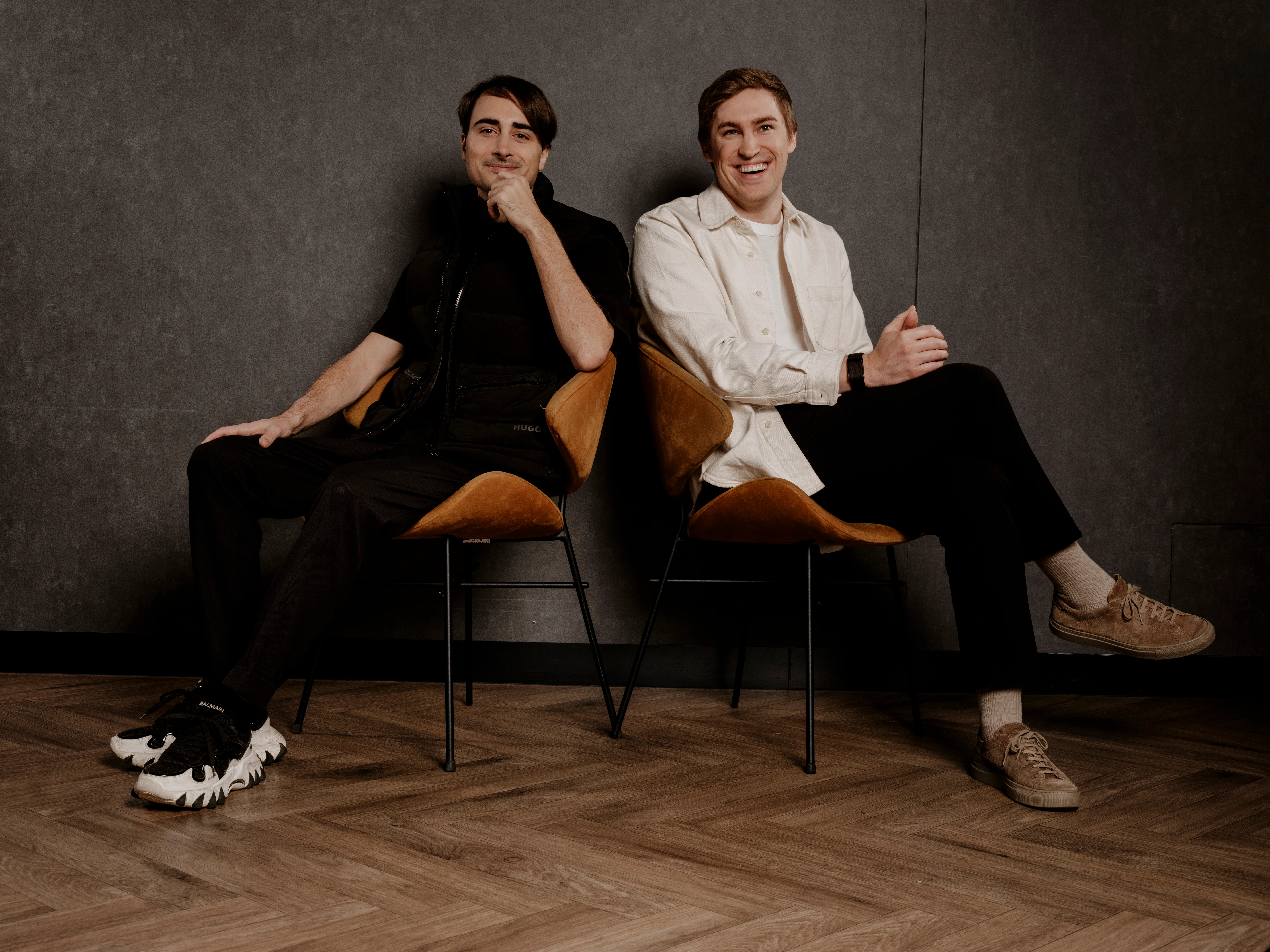
OFFICIAL Mati Staniszewski and Piotr Dabkowski, co-founders of ElevenLabs. High school friends from Copernicus IB School, Warsaw. Mati (ex-Palantir) and Piotr (ex-Google, Cambridge MPhil) launched the company in 2022 after years of frustration with Poland's single-voice dubbing tradition. — ElevenLabs Press Kit
They co-founded ElevenLabs in April 2022 as a research-first company. Not a product company looking for a model. A research company building a model that would eventually earn a product. Mati had spent four years at Palantir learning how enterprise organizations actually adopt and embed software. Piotr had completed an MPhil at Cambridge, publishing his AI-based image detection thesis at NeurIPS 2017, one of machine learning's most selective conferences. Piotr is described on ElevenLabs' own site as "the first researcher to cross the threshold of human-like AI speech."
Twelve months in stealth. While every other AI startup was building ChatGPT wrappers and racing to ship, two Polish engineers who had grown up hating their lektor were training a model to understand not just what words say, but how they should feel.
Mati's announcement post on LinkedIn read: "Together with my best friend, and now co-founder, Piotr Dabkowski, we've started Eleven Labs! At Eleven, our mission is to make audio content universally accessible in any language. We're researching new methods for voice generation that preserve the distinctive features of speech — like emotions, intonation and intent — across languages." The first comment underneath, from a former Palantir colleague, read: "Boom! Never been more impressed by a demo. Everyone go check out elevenlabs.io now!" No sales pitch. Just a demo and a stunned reaction. That ratio never changed.
From $0 to $200M ARR in 36 Months
2022
Founded
Research-first, bootstrapped. Mati and Piotr building TTS models from scratch in stealth. LinkedIn announcement generates early buzz with no product yet shipped. First comment: "Boom! Never been more impressed by a demo."
2023
Beta Launch & $2M Pre-seed
Led by Credo Ventures. Platform commended for "generous free tier" and natural output quality. An audiobook author had already used the platform 500 times to create an entire book. 30-50 investors had rejected the company.
2023
Harry Potter by Balenciaga
demonflyingfox video reaches 11M+ views. Tutorials flood YouTube within 48 hours, all naming ElevenLabs for voice. Zero marketing spend. Zero prior relationship with creator.
2023
$19M Series A — $100M valuation
Led by a16z and Sequoia. Over 1M registered users in 5 months. Already embedded in 60% of Fortune 500 without formal sales outreach. ARR: $4.6M by year-end.
2024
$80M Series B — Unicorn at $1.1B
ARR: $25M. Lori Cohen is back in the courtroom. Congresswoman Jennifer Wexton makes history using ElevenLabs voice on the House floor in July. Company: ~70 employees.
2025
$180M Series C — $3.3B valuation
Co-led by a16z and ICONIQ. ARR at $90M. Conversational AI platform launches. 250,000 agents deployed within two months. Strategic investors: Deutsche Telekom, LG, HubSpot Ventures, NTT DOCOMO.
2025
$200M ARR. Reportedly profitable.
Achieved in 5 months from $100M mark in April 2025. 2,000% growth from 2023 base. 330 employees organized into 20 micro-teams of 5-10 people. Mati still personally interviews every hire.
2026
$500M raised — $11B valuation
Eyes IPO. Matthew McConaughey revealed as early investor and customer at ElevenLabs' inaugural Summit. Piotr: "When we started ElevenLabs, we couldn't have imagined the scale and impact we've reached today."
The Umm That Changed Everything
Most voice AI teams spent 2022 trying to eliminate the imperfections of speech. The pauses. The breath. The hesitations. The filler sounds. They treated "ums" and "ahs" as noise to be cleaned away, artifacts of humanity that undermined the polish of synthetic audio.
ElevenLabs did the opposite.
Mati described the team's inflection point in an interview with Endeavor. They knew they were on the right track, he said, when the model began adding those sounds in naturally. Not programmed. Not inserted. Learned. The AI had understood that these imperfections were not bugs in human speech. They were features. They were how humans signal that they are actually thinking. That they are actually present.
"We started seeing some of those human elements being replicated. The laughter. The breath. The pause before something difficult is said." — Mati Staniszewski, Endeavor
Siri and Alexa could pronounce words. ElevenLabs could perform them. The gap between those two things is the entire story. When they launched the beta platform in January 2023, the platform was commended immediately for its "generous free tier" and for something more unusual: its ability to accurately pronounce names with unique or uncommon pronunciations, addressing a common shortcoming that often catered primarily to Western names. That detail is not a footnote. It is proof that the model was trained on nuance, not just phonetics.
The pre-seed fundraising was brutal by Mati's own account: 30 to 50 investors passed on ElevenLabs in early 2023. Investors questioned whether the voice AI market existed and whether two young Europeans could compete against Google and Amazon. They eventually raised $2 million at a $9 million valuation, with exactly 11% equity sold, timed deliberately to align with the company name. Sequoia's Brian Kim later became the only investor to personally test ElevenLabs' APIs before investing, providing detailed technical feedback on voice quality and stability before writing a check. That detail says something about what kind of product earns that kind of diligence.
March 2023. One YouTube Video. Eleven Million People Ask the Same Question.
On a Tuesday in late March 2023, a creator called demonflyingfox uploaded a YouTube video. The title was "Harry Potter by Balenciaga." The premise was absurd: the characters of Harry Potter, reimagined as models in a Balenciaga fashion campaign, walking a runway, delivering dialogue in the actual voices of the original cast. Voldemort speaking with Ralph Fiennes' exact cadence. Dumbledore in Michael Gambon's register. Hermione with Emma Watson's breath patterns.
The video reached eleven million views. Elon Musk tweeted fire emojis. Film Twitter lost its mind. But the important number is not eleven million. The important number is zero. Zero marketing spend. Zero outreach. Zero seeding. Zero PR. The video spread because viewers experienced something that made them genuinely uncertain about what they were hearing. That uncertainty is not a marketing outcome. It is a product outcome.

VIRAL "Harry Potter by Balenciaga" by demonflyingfox, March 2023. Eleven million views. No budget. No PR. No affiliate link. The video spread because viewers could not explain what they were hearing in words. ElevenLabs had no relationship with the creator before or during the video. — YouTube / demonflyingfox
What happened in the hours after the video went live is the mechanism that no one talks about clearly enough. Creators did not share it because it was clever. They shared it because they could not explain it in words. The only way to share the experience was to share the video. And then, because audiences immediately asked "how did they make that," tutorials appeared within 48 hours. Every tutorial named ElevenLabs for the voice layer. ElevenLabs had not written any of those tutorials. ElevenLabs had not asked anyone to make them.
Most SaaS tutorials function as promotions. They explain what a tool does and why you should pay for it. The ElevenLabs tutorials that flooded YouTube in April 2023 were different. They existed because the creator needed to show the audience something the audience could not experience through description alone. The tutorial was not a promotion. It was a demonstration that the product forced into existence. The product was the spectacle. The affiliate link was incidental. Tutorials from April 2023 were still converting new users in March 2024, eleven months later, because curiosity-driven search intent does not expire the way problem-driven intent does.
Not Affiliates. Witnesses.
The ElevenLabs affiliate program offered 22% recurring commission for twelve months. It is frequently cited as the engine behind the creator wave. That framing inverts the causality. The commission did not create the behavior. It gave the behavior structure.
Creators were already making ElevenLabs content before the program existed, because the product gave them something genuinely worth showing. The affiliate program told them: be systematic about it. Instead of one viral demo, build a library. Instead of a single post, build a content strategy. The commission was an organizational principle applied to behavior that was already happening spontaneously.
With 100,000+ subscribers, Preece became ElevenLabs' most-cited affiliate case study. He built tutorials around ElevenLabs workflows that continued generating conversions eight months after publication. The 22% recurring commission gave him financial motivation to keep publishing. But the videos kept converting because the question they answered, "does this actually sound human?", never stopped being asked. The commission made him prolific. The product made him credible.
Another top-performing affiliate, Wilcock applied prominent affiliate link placement, clear calls to action, and content structured around genuine use cases rather than feature lists. Both he and Preece emphasize the same thing in ElevenLabs' own documentation: the product had to be real. Affiliate programs for mediocre products generate promotional content audiences identify and discount. The ElevenLabs content worked because creators were not pretending to be impressed.
The creator behind "Harry Potter by Balenciaga" was not an ElevenLabs affiliate when the video went viral. He made the video because he could. The company had no relationship with him before March 2023. The video was user-generated, spontaneous, uncompensated proof that the product worked at a level that justified the cultural attention it received. Zero contractual obligation. Zero commission. The most valuable ad ElevenLabs ever ran.
One of the use cases ElevenLabs did not anticipate was the explosion of faceless YouTube channels using AI voiceovers. Finance. History. Tech commentary. Creators who had no interest in appearing on camera discovered that ElevenLabs could produce narration indistinguishable from a professional voice actor, for a monthly subscription cost less than a single recording session. This segment became a significant driver of creator-tier subscriptions throughout 2023 and remains so today.
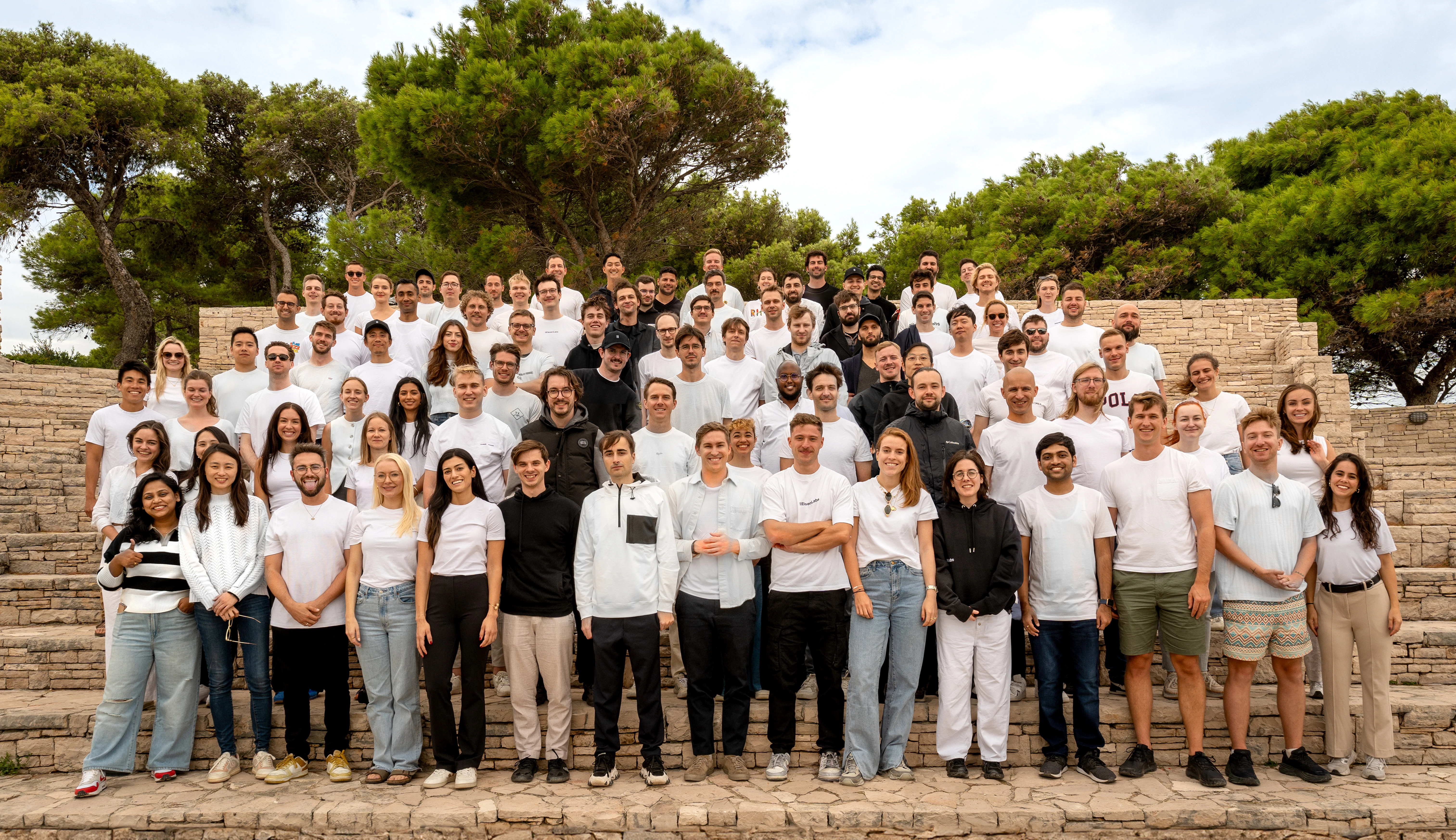
OFFICIAL The ElevenLabs team. From 8 people at January 2023 launch to 70 by year-end, to 330+ by September 2025. Mati still personally interviews every hire. — ElevenLabs Press Kit
The Courtroom. The Congress Floor. The Voice That Came Back.
There is a category of evidence that no marketing team can create on purpose. It happens when the product solves a problem so serious that its solution becomes newsworthy on its own terms. ElevenLabs accumulated these stories in 18 months. Each one did something that benchmark comparisons and G2 reviews cannot: it collapsed the distance between the product's technical claims and a human stakes outcome that anyone could understand.
Lori Cohen — "Lola"
Lori Cohen spent 33 years as a trial attorney at Greenberg Traurig. Fifty-eight defense verdicts. Recognized by The National Law Journal as one of the 50 most influential women lawyers in America. In March 2022, she woke up and could not speak. Her doctors still have not identified the cause. She tried intensive speech therapy, experimental surgeries, acupuncture, and, in the detail you remember, Russian gravitational weightlifting.
Her colleague Gerard Buitrago found ElevenLabs. They fed the system old recordings, court presentations, interviews. ElevenLabs produced a voice clone they named Lola. By Fall 2023, Lori Cohen was back in the courtroom, arguing motions through Lola. Jonathan Orent, an opposing attorney who had litigated against Cohen for years, said: "She is every bit as formidable now as she was before." The story won the Outstanding Achievement in Legal Technology award from Law.com and Legaltech News. ElevenLabs had not pitched a single journalist. The product outcome was the story.
Jennifer Wexton — The House Floor
Jennifer Wexton was a Virginia Democratic congresswoman. In 2023, she was diagnosed with progressive supranuclear palsy, a degenerative neurological disorder she described as "Parkinson's on steroids." It took her voice. She initially used a standard text-to-speech app in House speeches. A fellow Virginia congressman, Don Beyer, heard her through it and described it as "sounding like a robot."

NBC NEWS / AP Rep. Jennifer Wexton on the House floor, July 25, 2024, using ElevenLabs' AI voice clone of her pre-illness voice via iPad. The first time an AI-cloned voice was used in the United States Congress. ElevenLabs proactively reached out to her office after seeing her use a robotic text-to-speech app on TV. — NPR / AP
ElevenLabs reached out proactively after seeing media coverage of Wexton speaking through the robotic app. Her team provided an hour of past floor speeches and public appearances. In days, ElevenLabs returned her voice. Not a voice. Her voice. In July 2024, Wexton rose on the House floor and delivered remarks in the voice she thought she had lost. It was the first time an AI-cloned voice had ever been used in the United States Congress.
"I used to be one of those people who hated the sound of my voice. When my ads came on TV, I would cringe and change the channel. But you truly don't know what you've got til it's gone, because hearing the new AI of my old voice for the first time was music to my ears. It was the most beautiful thing I had ever heard." — Rep. Jennifer Wexton, House floor, July 25, 2024
Beyer, the colleague who had described the robotic version, said of the ElevenLabs version: "To have her voice back through the AI, and not just a voice but her voice, is a really wonderful thing." That distinction Beyer draws is the entire product thesis. Not a voice. Her voice. The story ran in NPR, the Associated Press, PBS NewsHour, Bloomberg Law, and CNN Politics. Zero PR spend from ElevenLabs.
Why Murf, PlayHT, and Resemble AI Could Not Catch Up
By mid-2023, there were at least a dozen well-funded competitors in the AI voice space. PlayHT had raised $8 million. Murf had raised $11.5 million and built a polished enterprise product with team collaboration features, video integration, and Canva compatibility. Resemble AI had raised $8 million and focused specifically on voice cloning with an emphasis on deepfake detection. All of them were technically competent. None of them generated a Harry Potter Balenciaga moment.
The reason is structural, not strategic. The reveal mechanism only works when the output creates genuine sensory uncertainty. The question a viewer must ask is not "is this a good AI voice?" but "wait, is this actually a real person?" That second question requires a quality threshold that is not a matter of degree. It is a matter of kind. You either produce output that passes the human test in spontaneous, uncontrolled listening conditions, or you do not. There is no partial credit.
| Company | Funding (2023) | Viral Creator Moment | Emotional Affect | Fortune 500 Reach |
|---|---|---|---|---|
| ElevenLabs | $21M (Jun 2023) | Yes — unplanned | Automatic, learned | 60% pre-sales |
| PlayHT | $8M | No | Manual tags only | Not disclosed |
| Murf AI | $11.5M | No | Template-driven | Limited |
| Resemble AI | $8M | No | Partial | Enterprise niche |
Murf built a better enterprise workflow product. Collaboration features, role-based permissions, approval workflows. The kind of product a procurement team could evaluate on a feature matrix and approve. That is precisely why it lost the ground floor. Enterprise adoption of ElevenLabs did not come through procurement. It came through developers and content teams who had already been using the product for months without budget approval. By the time procurement entered the conversation, the evaluation was over. ElevenLabs had already passed every relevant test, informally, in production.
PlayHT built a broader language library. 142 languages versus ElevenLabs' early 29. Breadth is a spreadsheet advantage. Depth is a sensory one. In the era of reveal-driven distribution, sensory advantage compounds and spreadsheet advantage sits in a tab that never gets opened. Resemble AI built genuine security infrastructure. Deepfake detection. On-premises deployment. Watermarking. Real enterprise needs. But needs that arise after adoption, not before it. ElevenLabs had reached 60% of Fortune 500 before those conversations were relevant.
The competitors who built enterprise-grade products assumed enterprise was the starting point. ElevenLabs understood that enterprise was the endpoint. The starting point was a person stopping mid-task to ask someone across the room: "Did you just hear that?"
60% of Fortune 500 Arrived Before the Sales Team Did
Enterprise software adoption normally follows a specific sequence: vendor identifies target account, SDR makes initial contact, AE runs discovery, solution engineer runs technical evaluation, procurement evaluates risk and cost, legal reviews terms, contract is signed, implementation begins, users are trained, usage begins. The entire sequence exists to answer one question: does the product work for us?
ElevenLabs collapsed that sequence. The developers and content teams inside Fortune 500 companies did not ask procurement whether they could try ElevenLabs. They opened a browser tab. They created a free account. They used the product to solve an actual problem they had that week. Then they kept using it. Then a colleague saw the output and asked how they made it. Then two people were using it. Then a team. Then a department head noticed. Then a purchase order arrived in ElevenLabs' inbox to formalize what had already happened.
The Conversational AI product that ElevenLabs launched in November 2024 generated 250,000 deployed voice agents within two months. Not experiments. Production systems. Production systems carry switching costs, deep integrations, and high replacement stakes. The product became infrastructure before the company had to sell it as infrastructure. By the time procurement arrived, the switching cost had already been paid, in the opposite direction.
The Five Things That Actually Built This Company
The ElevenLabs story is not about affiliate programs or product-led growth or creator seeding. Those are descriptors of activity. The story is about a specific causal chain that only works when one condition is present: the output must be good enough that the first person who hears it cannot stop thinking about who made it.
Everything else is downstream of that. The tutorials are downstream. The affiliate conversions are downstream. The Fortune 500 adoption is downstream. The $11 billion valuation is downstream. The chain begins with a product that produces a sensory experience for which the only adequate response is demonstration, not description.
Five principles transfer directly from this case, and they apply in sequence. First: founder frustration sets a quality bar that no market research can replicate. Mati and Piotr knew what bad sounded like because they had lived with it. That is why they spent twelve months building in stealth when every incentive in venture-backed startup culture pushed them to ship faster. Second: the reveal only works when the output cannot be adequately conveyed in words. Most software can be described. ElevenLabs had to be heard. If you can explain your product's value in a tweet, you cannot generate reveal-driven distribution. If someone has to make a video to share what they experienced, you can.
Third: affiliate programs are amplifiers, not engines. The commission made creators prolific. The product made them credible. Those are not the same mechanism. If you do not have a product that produces genuine sensory surprise, a 22% recurring commission will generate promotional content that converts like promotional content. Which is to say, barely. Fourth: enterprise adoption is a consequence of creator adoption, not a parallel track. The sequence matters because it is not reversible. A company that goes to enterprise first never gets the grassroots embedding that makes the sales conversation an expansion conversation rather than an evaluation one.
Fifth: infrastructure retention is earned before it is sold. When 250,000 voice agents are running on your platform, you are not a tool anymore. You are architecture. The switching cost is not evaluated. It is felt. No competitor can overcome that through pricing or features. They would have to convince 250,000 developers to rebuild what they already built.
ElevenLabs did not shorten the sales cycle. It removed the need for one. The sales cycle exists to answer the question "does this work?" ElevenLabs answered that question in courtrooms, on the floor of Congress, in 11 million YouTube views, and in the production systems of every Fortune 500 developer who quietly opened a browser tab and never went back to whatever they were using before.
Sources: ElevenLabs press kit (elevenlabs.io/press), Endeavor case study, Wikipedia, Bloomberg Law, NPR, Associated Press, PBS NewsHour, CNN Politics, Law.com, Yahoo Finance, Sifted, SaaStr, Electroiq Statistics, Sacra, Contrary Research, GetLatka. Mati Staniszewski LinkedIn post Aug 2022. 20VC with Harry Stebbings podcast, Sep 2025. Traffic data: Semrush / Similarweb. Funding data from public announcements. ARR figures from company disclosures and investor memos. Jennifer Wexton photos via AP / House Television / NBC News.